Why content management is key to your success
11 min read

Why Content Management Is Essential for Your Success
In brief:
- Effective content management increases organic traffic and builds long-term customer trust. It improves search engine visibility, reduces costs, and strengthens brand authority. The focus is on strategic planning, consistent publishing, and measurable results.
Content management (CM) is the systematic process of creating, organizing, publishing, and distributing digital content, forming the foundation of every company's successful digital presence. Why content management is essential becomes clear as soon as you look at the numbers: optimized content captures 20–30% more monthly search traffic compared to non-optimized content. This is no coincidence but the result of a deliberate approach to content. Companies that manage content strategically build long-term customer trust, reduce customer acquisition costs, and maintain consistent visibility in search engines. Those that do not rely on advertising that stops delivering results the moment they stop paying for it.
What Are the Main Benefits of Effective Content Management?
Effective content management provides businesses with concrete, measurable benefits that paid advertising cannot replace.

Organic traffic and SEO visibility are the first and most important benefits. Content that answers your customers' questions appears in search engines without any cost per click. A company that consistently publishes high-quality articles on topics relevant to its customers builds a content library that works around the clock. Paid advertising stops working the moment you pause your budget. Organic content remains.
Cost efficiency is one of the main reasons why more companies are adopting content marketing. Once created and properly optimized, content continues attracting visitors for months or even years after publication. Compared to paid advertising, where every click comes at a cost, this is a far more sustainable growth model.
Building brand authority is the third benefit, and one that is often underestimated. When a company consistently publishes valuable, expert content, it becomes a trusted reference within its industry. Customers trust companies that help them understand complex topics before asking them to make a purchase. This trust takes time to build, but it is remarkably resilient.
In addition, two more benefits deserve attention:
- Greater customer engagement: Content that solves real problems encourages comments, shares, and feedback. It creates a dialogue that advertising simply cannot.
- Strategic flexibility: A well-organized content management system allows you to adapt quickly to emerging trends, seasonal topics, or changes in customer behavior.
Expert tip: Before creating new content, review what you already have. Often, the fastest way to achieve better results is to update older articles with fresh information and a stronger structure rather than starting from scratch.
How Does Strategic Content Management Work?
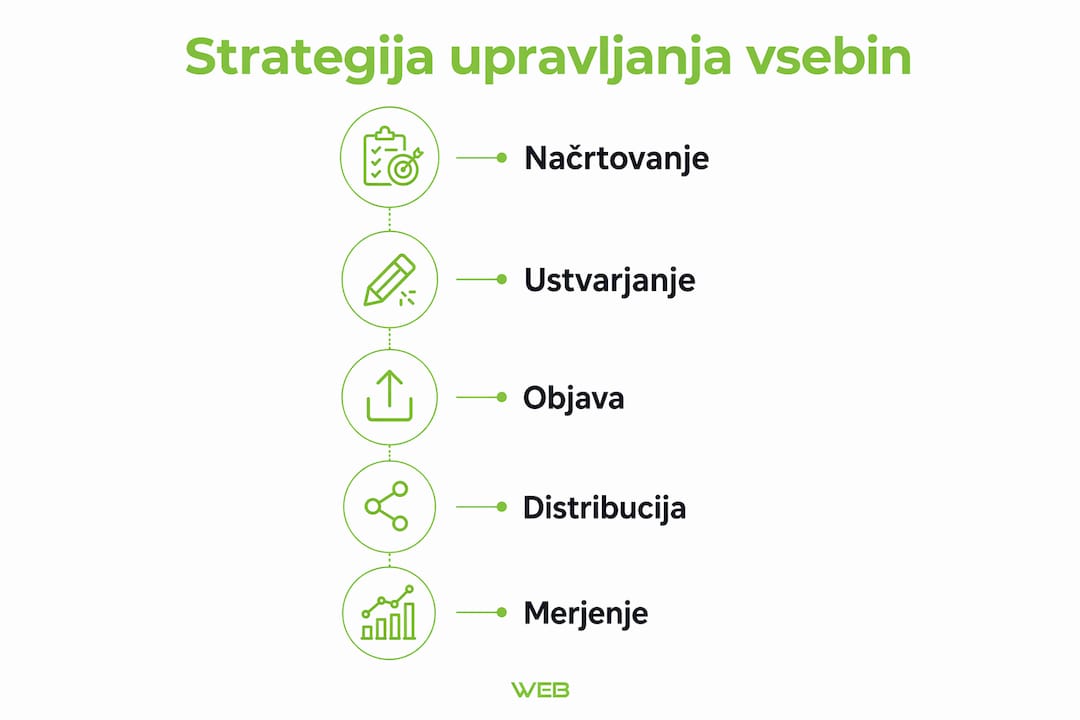
Strategic content management is much more than simply writing blog posts. It is a structured process that includes planning, creating, reviewing, publishing, and measuring content.
Content Pillars as the Foundation of Planning
Content pillars are 3–5 core topics that cover your company's primary area of expertise. Each pillar is then divided into subtopics and individual articles. This approach offers a practical advantage: companies that plan content using content pillars reduce the time required to prepare a monthly content plan from several hours to less than 45 minutes. Instead of lengthy meetings asking, "What should we write about this month?", marketing managers follow a clear framework and focus on execution quality.
For example, a company selling accounting software might have pillars such as "Tax Legislation," "Cash Flow Management," "Accounting Digitalization," and "Entrepreneurship Tips." Each pillar covers a different aspect of the business while collectively demonstrating comprehensive expertise.
Content Management Systems (CMS)
CMS platforms allow users to create, edit, and publish content without technical expertise. This is essential for marketing managers who need to respond quickly to market changes. When industry updates occur, you should not have to wait for a developer to update your website. A good CMS gives you control.
In practice, the content management process consists of four steps:
- Planning: Define the topics, keywords, and goals for each piece of content. Who is the reader? What do they want to learn? Which stage of the buyer's journey does this content support?
- Content creation and editing: Write, edit, and optimize the content for SEO. Include headings, meta descriptions, internal links, and visual elements.
- Review and publishing: In larger teams, content goes through a review process before publication. A CMS facilitates this through workflows and user roles.
- Distribution and measurement: Share your content across the appropriate channels and measure the results. Traffic, time on page, inquiries, and conversions are your key performance indicators.
Expert tip: Structured content management built around clear content pillars is what separates businesses with a consistent presence from those that publish randomly and wonder why they see no results. Clarity and consistency are essential.
For agencies and businesses looking for deeper insights into how structured content planning influences SEO growth, this is an area well worth exploring in greater detail.
How to Improve Results with Content Marketing
Content marketing is built on three pillars: understanding your audience, SEO optimization, and thoughtful distribution. Without all three elements, even high-quality content remains invisible.
Focus on Questions, Not Just Keywords
A common mistake in content strategies is focusing too heavily on keywords instead of understanding customer needs. The Answer Everything Optimization (AEO) approach improves visibility by answering specific questions rather than simply including search terms. This is especially important for visibility in AI-generated answers, which are increasingly becoming a primary source of information.
For example, instead of writing an article titled "Accounting Software," write "How to Choose Accounting Software for a Company with 10 Employees." The second title answers a specific question that potential customers are actually typing into search engines.
Distribution Is Often More Important Than the Content Itself
A large portion of published content never reaches even 100 monthly visitors, while content backed by a distribution strategy reaches thousands. This means creating content without a distribution plan wastes both time and money. Every article needs a distribution path: an email list, LinkedIn, niche communities, partner websites, or internal links from existing content.
For example, a company that publishes a high-quality guide on tax deductions for entrepreneurs but never shares it anywhere will achieve minimal reach. The same company that emails the guide to its subscriber list, shares it on LinkedIn, and links to it from existing website articles will generate significantly more traffic.
Measure the Right Metrics
Measuring content performance is a step many businesses skip. The key metrics you should monitor include:
- Organic traffic: How many visitors come from search engines?
- Time on page: Are readers actually consuming the content, or do they leave immediately?
- Inquiries and conversions: Does the content generate tangible business results?
- Search engine rankings: Are your key pages moving higher in search results?
A company with 40 well-maintained pieces of content will outperform one with only five outstanding but isolated articles over the long term. Volume and consistency together build topical authority, which search engines reward. For practical advice on improving website conversions, it is essential to understand how content guides customers through the buying journey.
What Is the Difference Between Content Management and Knowledge Management?
Content management (CM) and knowledge management (KM) are two distinct disciplines that are often confused, even though each serves a different purpose within an organization.
CM focuses on the content lifecycle: creating, editing, publishing, and distributing digital materials. KM, on the other hand, encompasses the broader process of capturing, sharing, and managing organizational knowledge. CM ensures that the right content reaches the right audience at the right time. KM ensures that valuable knowledge stays within the company and isn't lost when employees leave.
| Aspect | Content Management (CM) | Knowledge Management (KM) |
|---|---|---|
| Primary goal | Publishing and distributing content | Capturing and sharing knowledge |
| Primary users | Marketing team, readers | The entire organization |
| Tools | CMS platforms, editorial calendar | Internal wiki, knowledge bases |
| Outcome | Visibility, traffic, conversions | Innovation, team efficiency |
| Time horizon | Short- and long-term cycles | Long-term organizational growth |
Integrating both approaches creates powerful synergy. A company that continuously educates its team and encourages knowledge sharing achieves greater innovation and delivers a better customer experience. In practice, this means that when your sales team systematically shares insights from customer conversations with the marketing team, marketing can transform that knowledge into content that answers real customer questions. The loop is complete.
The complexity of today's digital ecosystem requires an integrated approach that combines CM and KM for continuous adaptation and growth. Companies that understand this gain a lasting competitive advantage over those that treat content and knowledge as separate disciplines.
Key Takeaways
Content management is the foundation of digital growth. Without a systematic approach to creating, distributing, and measuring content, businesses lose traffic, customer trust, and revenue to competitors.
| Key Point | Details |
|---|---|
| Organic traffic increases | Optimized content captures 20–30% more search traffic without any cost per click. |
| Content pillars save time | Structured planning with 3–5 content pillars reduces monthly planning time to less than 45 minutes. |
| Distribution determines reach | Content without a distribution strategy often fails to reach even 100 visitors per month. |
| CM and KM complement each other | Integrating content and knowledge management leads to greater innovation and improved team efficiency. |
| Measurement is essential | Traffic, conversions, and search rankings are the key metrics that reveal whether your strategy is working. |
Why Most Companies Get Content Wrong
When I work with business owners and marketing managers, I notice one recurring mistake: content is created reactively. Someone says, "Let's write a blog post," a topic is chosen based on intuition, the article gets published, and then it's forgotten. A month later, the same process repeats. The result is an archive of disconnected articles that build no authority and generate little to no traffic.
Systematic content management works differently. It starts with a simple question: "What questions do our customers ask before making a purchase?" The answer becomes the foundation of your content plan. Once you establish this framework, creating content becomes faster, more valuable, and far more effective at delivering measurable results.
The second mistake is neglecting distribution. I've seen excellent articles sit on a website for months with virtually no traffic simply because no one made sure people would actually find them. Distribution is not promotion in the negative sense. It's a responsibility to the content you've invested time and effort into creating.
The third mistake is fearing volume. Entrepreneurs often believe it's better to publish one exceptional article each month than four average ones. The data suggests otherwise: a company with 40 well-maintained pieces of content will outperform one with only five isolated articles over the long term, regardless of the quality of each individual post. Topical authority is built through consistency and scale, not occasional masterpieces. Start small, but start today—and don't stop.
— Ziga
Moxy-web: Your Partner in Digital Content Management
A strong content management system requires a solid technical foundation. Moxy-web develops web solutions that enable marketing managers and business owners to manage content independently through an intuitive user interface, without relying on developers. Every website built by Moxy-web is designed so you can manage it yourself: publish articles, update pages, and monitor performance. In addition, Moxy-web provides technical support, hosting, and integration with third-party systems, ensuring your content strategy runs on reliable infrastructure. If you'd like to learn how a custom web solution can support your content strategy, get in touch with the Moxy-web team.
Frequently Asked Questions
What Is Content Management and Why Is It Important?
Content management is the systematic process of creating, organizing, and distributing digital content. It helps businesses increase organic traffic, reduce marketing costs, and build long-term customer trust.
How Do I Start a Content Strategy for My Business?
Start by defining 3–5 content pillars that address your customers' most important questions. Use these pillars to build a monthly content plan and execute it consistently.
How Much Content Do I Need to Publish Before I See Results?
Consistency and volume matter more than isolated successes. A company with 40 well-maintained pieces of content will outperform one with only five isolated articles because search engines reward topical authority.
What Is the Difference Between Content Management and Knowledge Management?
Content management focuses on the lifecycle of digital content intended for external audiences. Knowledge management captures and shares internal expertise within an organization to improve team efficiency and organizational learning.
How Do I Know Whether My Content Strategy Is Working?
Track organic traffic, search engine rankings, time on page, and conversions. If these metrics improve within 3–6 months of implementing your strategy, you're moving in the right direction.