WordPress or custom development?
8 min read
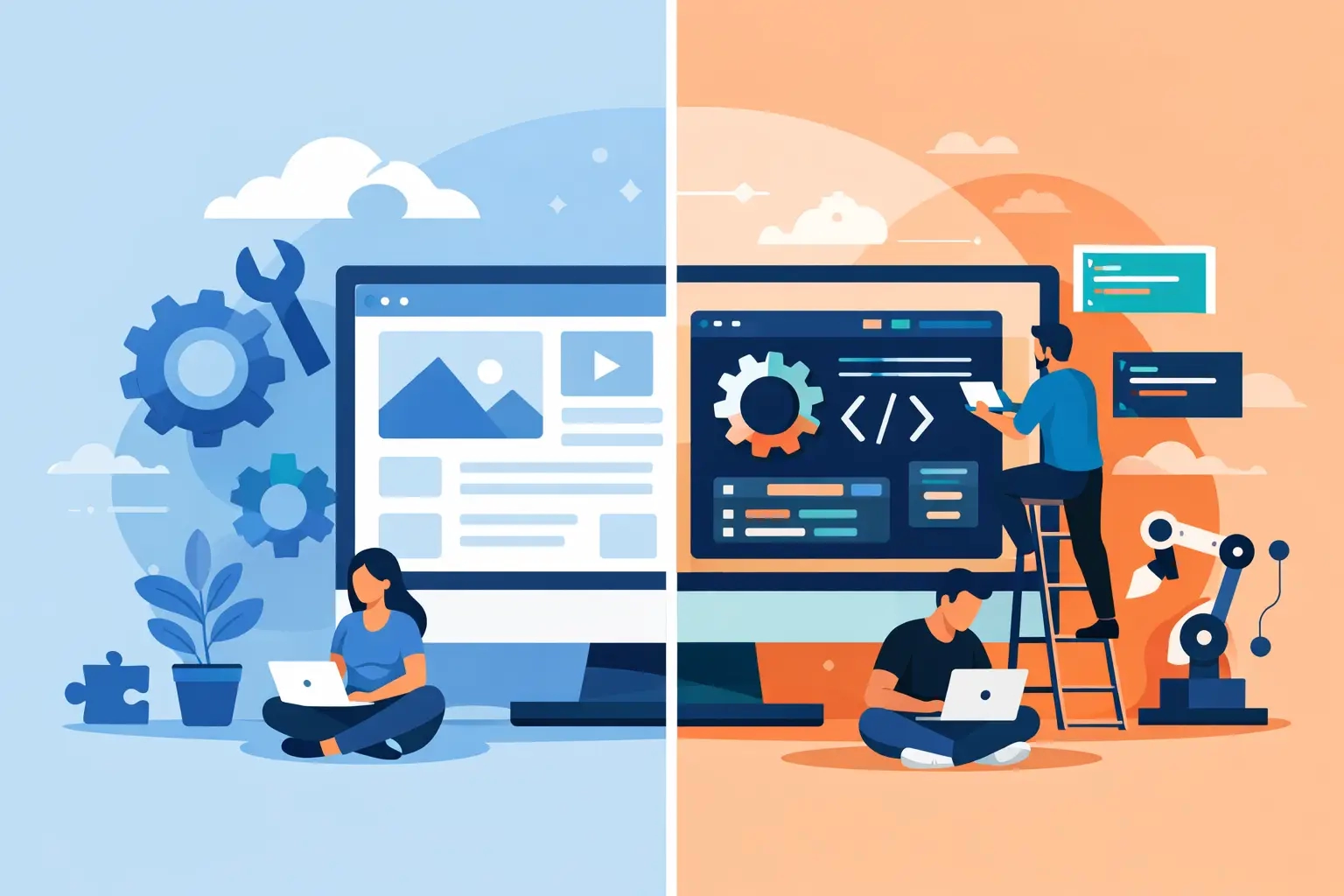
When a company starts planning a new website, online store, or application, one question usually comes up very quickly: WordPress or custom development? This is not a technical dilemma for developers, but a business decision. It determines how quickly you can launch the project, how much freedom you will have for upgrades, and whether the solution will still serve you well in two years or start limiting your growth.
The wrong choice rarely becomes obvious in the first week. It becomes apparent later, when you need integration with an ERP system, custom pricing logic, multilingual support, a new sales process, or a better user experience. That is when it becomes clear whether you built a platform for growth or simply a website that looked good enough at the beginning.
WordPress or custom development – what are you really comparing?
Many companies oversimplify this comparison. On one side, WordPress is seen as the fast and affordable solution, while custom development is viewed as the more expensive option for demanding projects. In practice, the difference is much broader.
WordPress is a content management system that is very useful when you need a clear presentation website, blog, simpler online store, or a solution that can be launched relatively quickly. Its main advantage is that many core features already exist, so there is no need to build everything from scratch.
Custom development means the solution is designed around your business processes, goals, and technical requirements. This does not necessarily mean coding absolutely everything from the ground up. It does mean, however, that the system architecture, functionality, administration, and integrations with other tools are not restricted by the limitations of a generic platform.
The key question, therefore, is not which option is more modern. The real question is which option better supports the way your business operates.
When WordPress is the right choice
WordPress can be an excellent decision if you have a clear and relatively standard set of requirements. This especially applies to companies that need a high-quality presentation website, simple content management, a strong blogging section, and a smooth basic user experience.
It also makes sense when you want a faster launch and do not require complex business logic behind the scenes. If your focus is primarily on service presentation, inquiry forms, basic optimization, and easy content editing, WordPress is often more than sufficient.
Another major advantage of WordPress is its user-friendliness. After a short onboarding process, your team can independently manage news, references, content, and landing pages. For many companies, this is an important benefit because they do not want to depend on a developer for every small change.
However, there is an important caveat. WordPress is only a good choice if it is implemented thoughtfully. The issue is not the system itself, but projects overloaded with too many plugins, generic themes, and quick shortcuts. Such websites may initially appear cheaper, but later become slow, vulnerable to security risks, and difficult to upgrade.
When custom development delivers more value
Custom development becomes the right choice when the web solution is not just a marketing channel, but an actual operational tool. This applies to more advanced e-commerce stores, portals, booking systems, configurators, membership platforms, and all projects where standard functionality is simply not enough.
If you have unique sales processes, different user types, advanced permissions, automations, or integrations with accounting, logistics, and other business systems, custom development usually wins in the long run. Not because it is more prestigious, but because it prevents the compromises that quickly start piling up in generic solutions.
The same applies to companies with clear growth ambitions. If you already know that you will expand the solution, enter new markets, introduce special features, or build your own digital processes, it is smart to think several steps ahead. What looks like savings today can become an expensive correction tomorrow.
With custom development, you also gain more control over the administration interface. This is often an overlooked advantage. Instead of your team adapting to the logic of a third-party system, the admin panel is adapted to your workflow. This means fewer mistakes, faster work, and better oversight.
Cost is not just the initial price
When deciding between WordPress or custom development, many clients first compare the quoted price. That is understandable, but it is not enough.
WordPress generally has a lower entry cost. If the project is simple in terms of content and functionality, this can be a rational decision. The problem arises when the initial scope appears simple, but hidden requirements later require additional plugins, manual adjustments, and future fixes.
At that point, costs no longer appear upfront but during usage. Adding features becomes slower, testing more demanding, and updates more risky. If the system is poorly designed, every change starts creating new problems.
Custom development requires a higher initial investment, but often comes with a lower cost of compromise. If the project requires specific logic, integrations, or serious scalability, the total cost over two or three years may actually make more sense than a solution that only seemed cheaper at the beginning.
That is why the most honest answer is this: do not just ask how much development costs. Also ask how much maintenance, adaptation, and growth will cost.
Security, speed, and stability are not automatic
Every web solution must be secure, fast, and stable. This applies not only to online stores, but also to presentation websites. A slow website damages user experience, while a security vulnerability is not just a technical inconvenience but a business risk.
With WordPress, it is possible to achieve an excellent level of security and performance if the project is technically well-built, the hosting is appropriate, the components are reliable, and the system is regularly maintained. The problem appears when the website is assembled from too many plugins by different authors without clear quality control.
With custom development, security can be planned more precisely. The system contains only what you actually need, meaning there is less unnecessary clutter and fewer vulnerable points. Performance optimization is also often more accurate because there is no need to adapt a generic environment.
This does not mean custom development is automatically more secure. It simply allows for greater technical control when handled by an experienced team.
Content management must remain simple
One of the most common misconceptions is that custom development is necessarily harder to use. That is not true. A poorly built system is difficult to use regardless of the technology.
A well-designed WordPress setup can be extremely editor-friendly. The same is true for a custom solution. If the administration interface is thoughtfully designed, users see logical fields, clear modules, and only the features they truly need. This can often be even more intuitive than a general-purpose CMS filled with unnecessary options that provide no value to your team.
For a company, the most important thing is being able to manage content quickly, without confusion, and without fear of breaking something. Here, the system label is less important than the quality of implementation.
How to make the right decision
If you need a classic business website with a clear structure, service presentation, references, forms, and occasional content editing, WordPress is often an excellent choice. It delivers results quickly and, when properly implemented, serves its purpose very well.
However, if the web solution directly impacts sales, operational processes, or user experience in a more specific way, custom development quickly demonstrates its value. Especially if you need integrations with external systems, specialized workflows, or an architecture that will not fall apart after the first serious upgrade.
The worst decision is usually the compromise in between: when a project that clearly requires a custom approach is forced into a generic platform, and the consequences are patched for months or years afterward. This path is often more expensive, slower, and more stressful than making the right decision from the beginning.
That is why, when choosing, you should not focus only on the platform. Look at your business model, internal processes, growth plans, and the level of flexibility you will need one or two years from now. A good web solution is not the one launched the fastest, but the one that serves your business reliably for the long term.
In projects where design, performance, integrations, and long-term usability matter, the difference between an average and a thoughtful decision becomes obvious very quickly. And that is exactly where the greatest value lies — in choosing a solution built for your business, not for the average user.